
Pune-based last-mile delivery startup Dispatch Network has raised Rs 5 crore in a pre-seed funding round led by Antler India, with angel investors Krishi Fagwani, founder of Thrive, Yashin Mahadevia and Parth Modwadhia also participating.

Dispatch runs a fleet of delivery riders who carry orders for food delivery and quick commerce platforms. The startup uses its own AI model to decide which order each rider takes next and where the rider should wait for the one after, with the aim of cutting the distance riders travel without an order.
The raised capital will be used to grow the AI team behind that model, which the startup calls the Large Logistics Spatio-Temporal Model, or LLSTM.
Dispatch said its next goal is 50,000 orders a day across five cities.
The problem it is going after
According to the Dispatch Network, every delivery app has its own peak hours and slack periods, so riders spend much of a shift waiting or riding empty, up to 50% of their kilometres without an order. The rider pays for fuel and wear on every one of those kilometres, but earns nothing on them.
Dispatch’s bet is that the fleet that can sustainably pay riders the most will attract the most riders, and that the only way to pay more is to make each hour on the road more productive.
To do that, it sequences work across several platforms instead of reacting to one order at a time. Many fleets let riders choose which order to accept. Dispatch instead assigns every order to a specific rider, which it said leads to better sequencing and fewer empty miles.
The startup said that LLSTM acts as a foundation model for intracity logistics and mobility. It learns from a minute-by-minute view of the city rather than from text, as large language models do. It assigns every order Dispatch delivers, and each decision, along with what happened next, becomes training data.
“Most of the world’s deliveries still run on rules someone wrote by hand. We’re building the decision layer for last-mile delivery: which order, which rider, and where they should be next. Pune is our training ground, and every delivery makes the model sharper,” said Navneeth Kannan, Co-founder, Product and AI, Dispatch Network.
Dispatch, which went live in Pune in June 2026, claims to have completed more than 100,000 deliveries since then, with monthly volumes rising from 3,014 in June to 55,000 in October. That is roughly an 18-fold jump in four months. It currently handles about 3,500 deliveries a day, so its 50,000-a-day target is about 14 times its present volume.
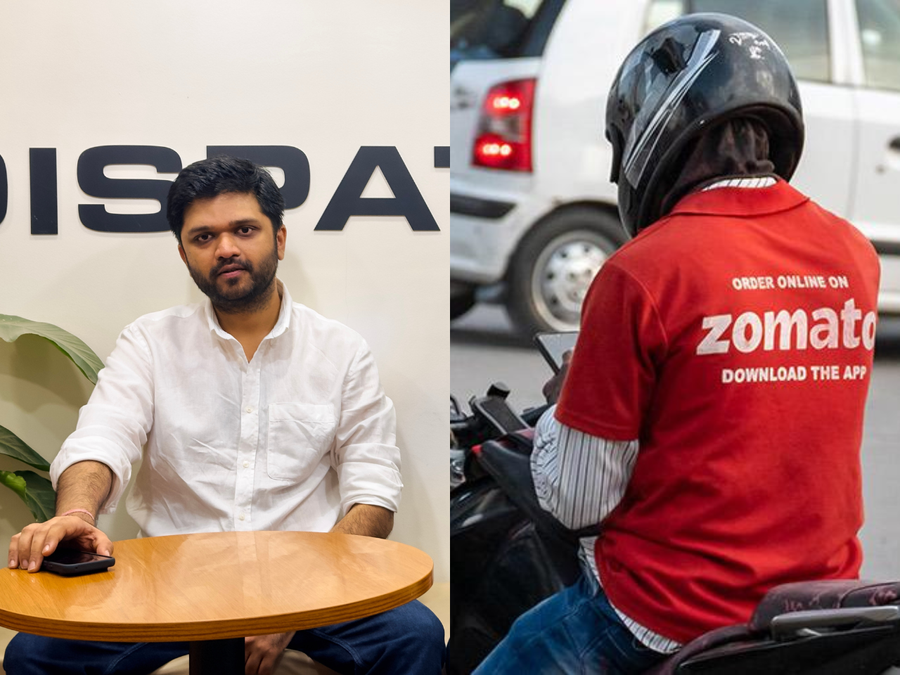
It delivers for Zomato, Swiggy, Zepto, Instamart and BigBasket, and for hundreds of restaurants and stores through its direct APIs and the Indian govt-backed Open Network for Digital Commerce (ONDC).
Mumbai, its second city, is due to launch in November.
“There’s no chance of coming back empty-handed,” said Rahul, 26, a Dispatch rider in Pune. “As soon as I come online, an order comes in fast; I don’t have to go around empty looking for hotspots. I earn more because I save more.”
Rajit Arya, Co-founder and CEO, said the last-mile system is broken by design. “On one hand there is immense unmet demand due to rider shortages; on the other, riders ride up to 50% of their time empty, without an order. Every platform fights for supply; no one makes money. It’s absurd,” he said.
“Riders need more orders, but more importantly, they need the right next order. Every idle minute we remove goes back into a rider’s earnings, and that’s how we win supply,” he added.
A NITI Aayog report released in June 2022 estimated that 7.7 million people worked in India’s gig economy in 2020-21, and projected that the number would reach 23.5 million by 2029-30.
Working conditions for delivery riders have also drawn government attention. In early January 2026, after a nationwide strike by gig workers on New Year’s Eve, the labour ministry directed quick commerce platforms to stop marketing 10-minute deliveries.