

The National Social Security Board, set up last week to finalise the scheme and oversee its implementation, will meet in the second half of this month to take a final call on the contours of the scheme.
Also Read: Gig workers get a seat at the table as Centre notifies social security boards
An industry expert who is part of the deliberations said the government wants to ensure that one segment of aggregators does not subsidise another; hence the inclination to make it transaction-based rather than turnover-based.
“There is a near consensus that charges should be levied only on the gig revenue attributable directly to the business,” another expert said.
 ET Bureau
A senior government official said that the scheme is almost ready and could be introduced in 2027, reflecting a keen focus on extending social security cover to gig and platform workers at the earliest.
Also Read: Majority of food delivery, quick-commerce riders seek clean restrooms, eating spaces: Report
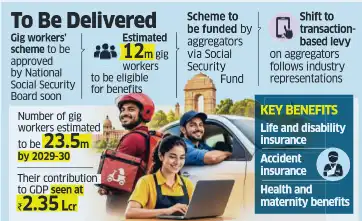
The scheme will be funded entirely by the aggregators through the Social Security Fund, with no contribution either from the Centre or gig workers, according to people with knowledge of the matter.
The scheme is expected to provide benefits such as life and disability insurance, accident insurance, health and maternity benefits. However, pension, provident fund and other old-age benefits may kick in later, once the government is convinced about long-term association of gig workers.
The proposed shift to a transaction-based levy on aggregators follows representations from the industry suggesting that the methodology for computing turnover differs across platforms. India’s gig workforce grew 55% to 12 million workers in 2025-26, as against 7.7 million in 2020-21, accounting for over 2% of India’s total workforce.
Niti Aayog projects India’s gig economy will reach 6.7% of the workforce by 2029-30, with an estimated 23.5 million workers and contribution of 2.35 lakh crore to the gross domestic product. The Social Security Code 2020 mandates 90 days of work in a financial year with a single aggregator, or 120 days cumulatively if working across multiple platforms, to access social security benefits under the provision.