

Mumbai-based managed workspace provider Redbrick Offices has secured about Rs 630 crore ($72 million), including conditional commitments, in equity across its Series A and Series A1 rounds, led by India SME Investments and Abakkus Asset Manager.

The funding is mostly a primary infusion, with a smaller secondary component through which some existing shareholders sold shares.
India SME Investments led the Series A round in March 2026. The Series A1 round was led more recently by Abakkus’s Four2Eight Opportunities Fund, and India SME Investments made a follow-on investment in it.
Evolvence Equity Partners, IIFL Capital Asset Management and UTI Alternatives were among the other investors in the extended round. UTI Alternatives had earlier invested in Redbrick through a structured convertible debenture issuance in March 2025.
Ladderup Corporate Advisory and IIFL Capital Services were financial advisers to the company, and Rajani Associates was its legal adviser.
What the capital is for
Redbrick plans to expand its managed office portfolio from about 6.5 million sq ft to more than 10 million sq ft over the next 18 to 24 months, an increase of roughly 54%.
It will also put money into technology infrastructure, design and service delivery, as it goes after workspace requirements from large enterprises and global capability centres (GCCs). The company said it is open to strategic partnerships and acquisitions that fit its growth plans.
“This funding validates our consistent focus on improving unit economics as well as demand backed sustainable profitable growth strategy. The equity raise will strengthen our capabilities, accelerate innovation, and renew our focus on addressing the customer’s requirements while acting as a long-term partner to large real estate developers,” said Ayush Goenka, chairman and MD of Redbrick Offices.
“As flexible asset-light corporate spaces become a core component of real estate strategy for multinationals and GCCs in India, Redbrick is positioned to capture massive market share,” said Ankit Aggarwal, senior vice president and senior fund manager, private equity at Abakkus. He added Redbrick as a capital-efficient business that has scaled while staying profitable.
“Our decision to back Redbrick in March 2026, amid peak global uncertainties, was anchored in our belief in Ayush and the management team’s track record of building a sizeable business in a bootstrapped manner, with a clear focus on profitable growth,” said Mitin Jain, founder and managing partner of India SME Investments. He added that the participation of other institutional investors in the latest round reinforced that view.
What Redbrick does
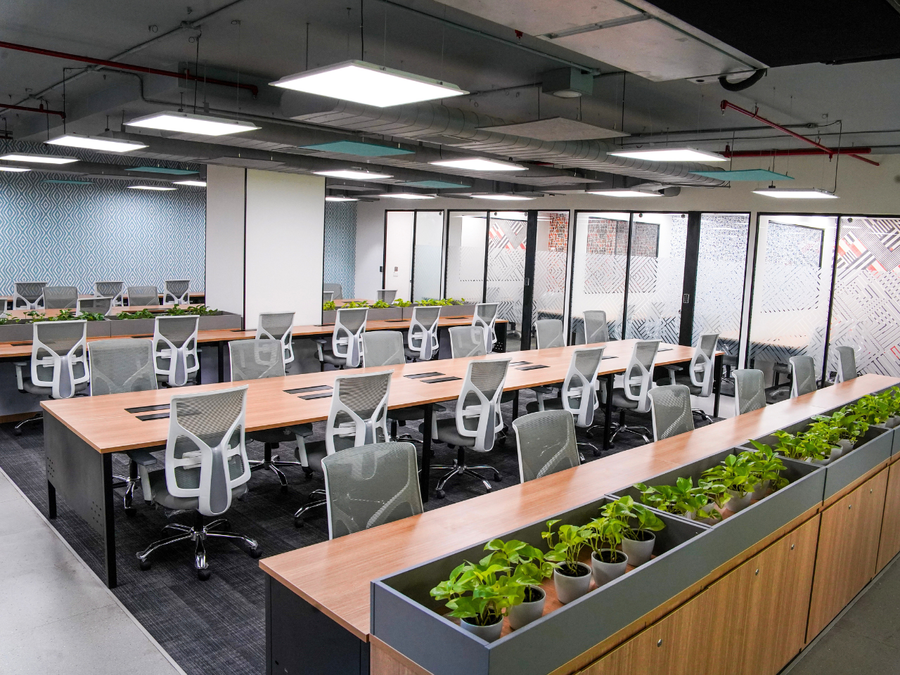
Redbrick runs more than 70 centres across eight cities, with over 1.15 lakh seats. It builds Grade-A offices to a client’s specifications and provides facilities management and hospitality-led services through a wholly owned subsidiary, Snow White Technologies & Services Private Limited.
Its clients include GCCs, Fortune 500 companies, large enterprises, BFSI firms and US-based multinationals.
The company counts brands such as Amazon, Salesforce, Flipkart, Cisco, HDFC, Lenovo, Panasonic, BASF and Roche among its clients, with plans to expand into Chennai and Kolkata during 2026-27.
The business started in Mumbai in 2015, when the Goenka family merged its sister company Bombay Connect with Redbrick. The family had been in real estate for decades before that.
Redbrick launched three centres in Mumbai in 2016, two in Hyderabad in 2017 and three in Pune in 2018. By 2019 it had 15 centres across those three cities.
According to the company, Redbrick Group manages assets worth Rs 5,000 crore and serves as the landlord for many of its managed properties, with an owned portfolio valued at over Rs 1,000 crore.
The fundraise comes as large companies and GCCs increasingly use managed offices to avoid long-term capital spending on fit-outs and operations.
A FICCI-CBRE report released in March 2026 put India’s flexible office stock at 110-114 million sq ft as of 2025, about three times the 2020 level, after growing at 23-25% a year over five years.
Bengaluru is the largest flex market with 30-32 million sq ft, followed by Delhi-NCR, Pune, Hyderabad and Mumbai, according to the report. International occupiers accounted for 55-60% of flex demand in 2025.
The report expects the share of GCCs that keep more than 10% of their office portfolio in flex workspaces to rise from 22% to 48% within two years. It valued India’s listed flex operators at about $2-2.2 billion as of 20 March 2026.