
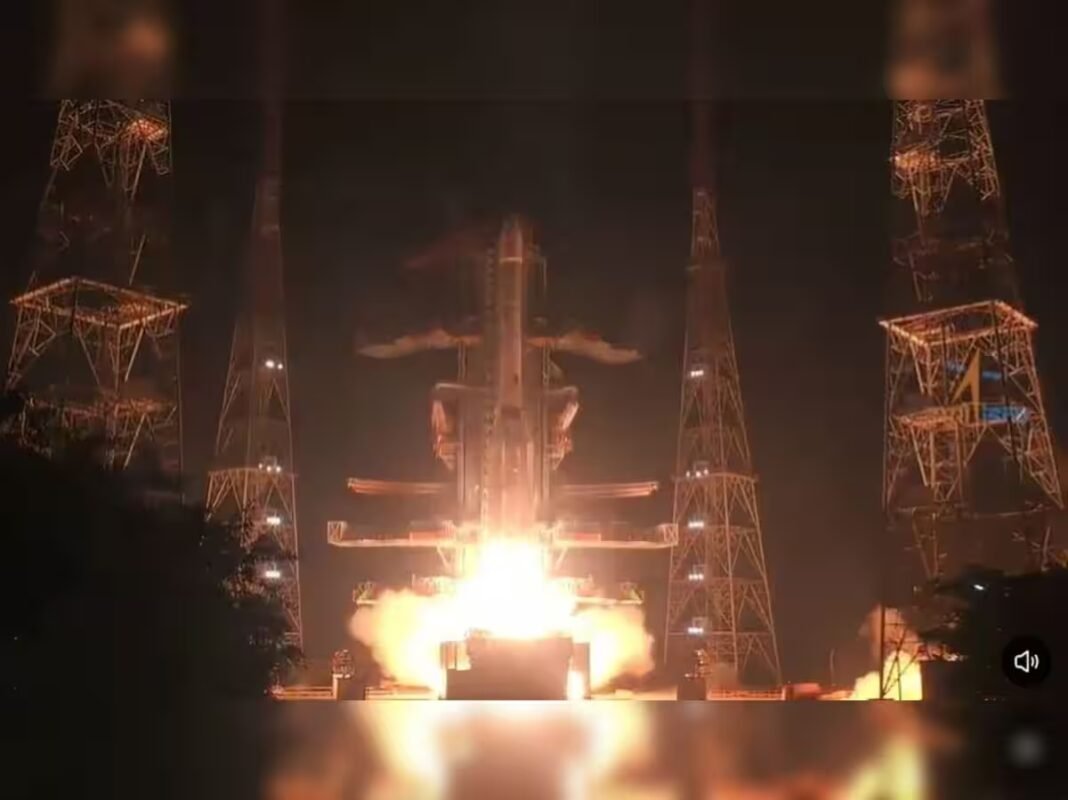
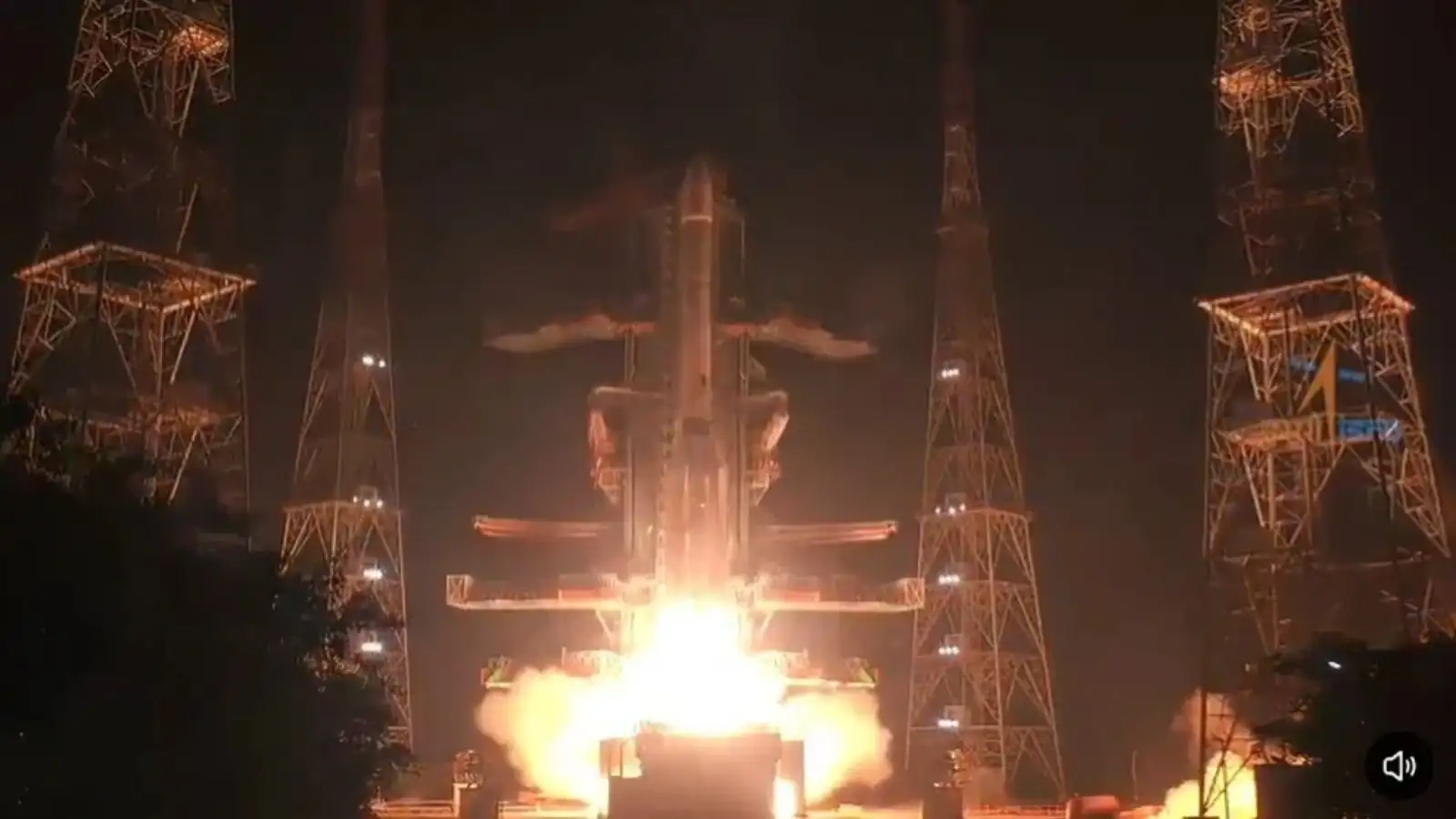
The rocket lifted off from the second launch pad at the Satish Dhawan Space Centre in Sriharikota at 11.51pm. After a flight of around 18 minutes and 40 seconds, the satellite was precisely injected into its designated elliptical orbit.
“GSLV-F18 has successfully and precisely injected the Navigation Satellite-03 weighing 2,250 kg in the intended elliptical orbit,” V Narayanan, chairman, Isro, said after the launch.
Narayanan said the satellite had been injected into an orbit of 170.3 km by 38,080 km, against a nominal target of 170.3 km by 37,247 km. “That is the precise performance. This is one of the best performances of any launch vehicle in the world,” he said.
With NVS-03, the NavIC constellation has been restored to its minimum operational configuration of four satellites, Narayanan said. “NavIC is a strategic national asset that provides the nation independent access to position, navigation and timing services,” he said.
NavIC provides positioning, navigation and timing services over India and up to 1,500 km beyond the country’s borders. The system has applications in areas including transport, shipping, surveying, disaster management and synchronisation of time.
Restoring NavIC to its minimum operational capacity would require Isro to launch at least two more NVS-series satellites, NVS-04 and NVS-05, in addition to the existing NVS-01 and NVS-03. These four satellites would form the minimum constellation needed to resume the system’s core navigation services. The launches would need to be carried out within a relatively short timeframe to ensure continuity.
However, four satellites would only meet the basic requirement. For greater reliability, stronger coverage and uninterrupted services, India would need additional backup satellites in orbit. This would mean building and maintaining a constellation of around six to seven NVS-series satellites to ensure the long-term stability of NavIC. However, according to the government, only three of the constellation’s 11 satellites are currently capable of performing their primary functions.
These include first-generation satellites IRNSS-1B and IRNSS-1I, along with second-generation satellite NVS-01. IRNSS-1B has already exceeded its designed 10-year lifespan, making its continued operation uncertain, while IRNSS-1I could remain functional until around 2028. NVS-01, if it performs as intended, has at least another decade of service ahead. Meanwhile, NVS-02, launched in January last year, was unable to raise its orbit after its onboard engines failed to fire, severely limiting its utility. As a result, NVS-01 is currently the only satellite that can be considered reliably operational over the long term.
NVS-03 is the third satellite in Isro’s second-generation NVS series. It carries an indigenous atomic clock and provides the L1 civilian navigation signal in addition to the existing L5 and S-band signals. The addition of the L1 band is expected to improve the system’s utility for civilian and commercial users and enable interoperability with other global navigation satellite systems.
The satellite has a mission life of more than 12 years and will undergo early orbit operations before being moved into its final slot.
Mission director Thomas Kurian said the launch campaign had been completed in 47 days, while the launch came just 56 days after the previous GSLV mission. “We also completed the preparation of the four L40 strap-ons within a record time of 37 days,” he said.
Kartik A, project director for the NVS-03 navigation satellite mission said the satellite would augment NavIC’s position, navigation and timing services over the Indian mainland and the surrounding region.
“Similar to its predecessors, NVS-03 also carries the indigenous atomic clock as well as the L1 band civilian navigation signal in addition to the heritage L5 and S signals,” he said. The signals, he added, would support civil, commercial and critical applications.
UP Rajeev, director, Vikram Sarabhai Space Centre, said GSLV-F18 had met all mission requirements and described the launch campaign as the shortest in the history of the GSLV programme.
“After GSLV-F17, we were able to launch F18 with the shortest launch campaign in the history of GSLV,” he said.
The spacecraft was reported to be healthy after separation, with its solar panels deployed. Isro said the satellite would be placed in its final operational orbit over the coming days.
Navigation with Indian Constellation (NavIC) is India’s indigenous alternative to the US Global Positioning System (GPS), Russia’s GLONASS and China’s BeiDou. The NVS satellite launch programme has seen several gaps between missions. NVS-01 was launched in May 2023, followed by NVS-02 in January last year, after a gap of 19 months. The next satellite, NVS-03, was launched on Friday, after nearly 20 months. Isro recorded three failures in six missions launched between January last year and January this year.
The United States operates the Global Positioning System (GPS), a satellite network that supports a vast range of civilian, commercial and military activities across the world. While 24 satellites are considered sufficient to provide global coverage and optimal performance, the US maintains a larger constellation of at least 30 satellites. This additional capacity acts as a safety net, ensuring uninterrupted and reliable services even if some satellites malfunction or go out of service.
China, meanwhile, runs its own satellite-based navigation network, BeiDou, as an alternative to GPS and to meet its domestic and global positioning requirements. BeiDou’s global navigation services are designed around a constellation of 30 satellites, with estimates suggesting that approximately 35 satellites are currently in orbit.