

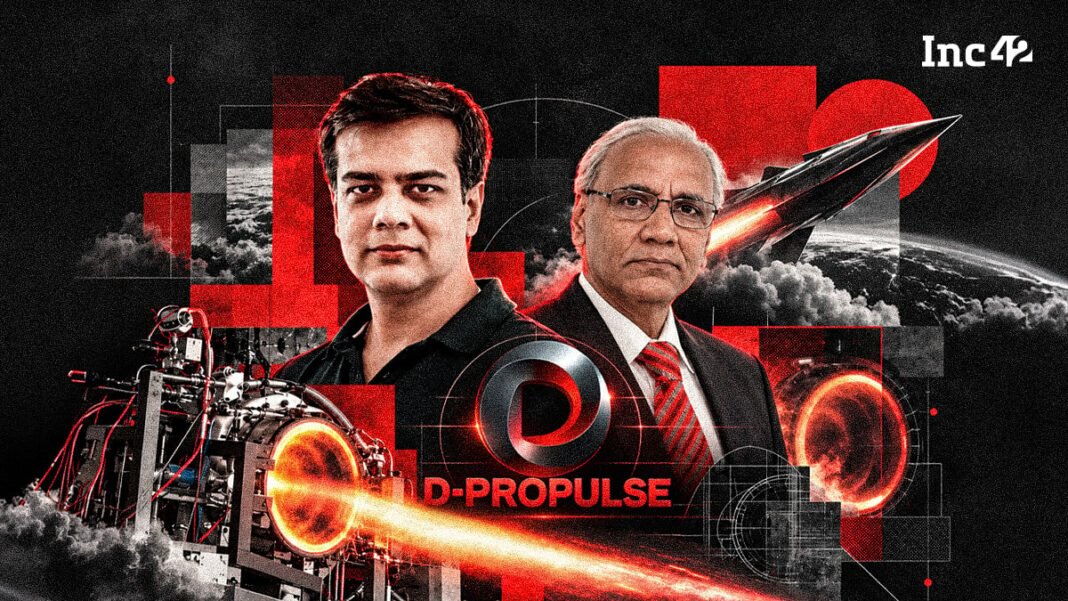
D-Propulse is developing rotating detonation engines (RDEs) that it claims could make jet engine technology cheaper and reduce India’s dependence on foreign suppliers
India has struggled for decades to develop homegrown jet engines, while D-Propulse sees an opportunity to build domestic propulsion technology and testing infrastructure
The startup has demonstrated a 5 kN air-breathing RDE and plans flight tests in 2027 and limited series production by 2028. With no revenue or clients yet, it is also exploring testing services as an early revenue stream.
For nearly four decades, India has chased the dream of building its own jet engine, but the breakthrough remains elusive. The result? Continued dependence on foreign technology, expensive imports, external vendors and lengthy overseas testing.
D-Propulse is attempting to address one part of this challenge through a new propulsion technology that promises lighter, more efficient engines for high-speed applications.
Founded in 2025 by defence analyst Saurav Jha and former DRDO scientist Dr V Ramanujachari, D-Propulse is developing rotating detonation engines (RDEs) for high-speed drones and missiles. Unlike conventional engines that burn fuel through a steady flame, RDEs use supersonic detonation waves to generate thrust, potentially improving fuel efficiency while reducing engine size and complexity.
Jha, who founded Delhi Defence Review, identified gaps in India’s indigenous propulsion capabilities through his work on military and strategic affairs. Ramanujachari, who previously led DRDO’s scramjet engine programme and contributed to the Akash missile’s propulsion system, had spent several years researching RDE technology at IIT Madras. Together, they saw an opportunity to translate that research into commercially viable propulsion systems.

An Indian Jet Engine For The World
Unlike conventional jet engines that burn fuel through a steady flame, D-Propulse’s rotating detonation engines (RDEs) use supersonic combustion waves to generate thrust.


Here’s how it works: A spark ignites a mixture of fuel and air, creating a shockwave that travels around a ring-shaped combustion chamber thousands of times a second. As it moves, the wave continuously compresses and ignites fresh fuel and air, producing high-pressure gases that are expelled to generate thrust.
This process could make RDEs more fuel-efficient, compact and mechanically simpler than conventional engines, potentially making them suitable for high-speed missiles and drones.
According to Jha, their engine is “15-25% thermally more efficient than an air-breathing jet engine”. He said the RDE requires simpler hardware, fewer moving parts compared with conventional gas turbines and can be produced at scale.
In July 2026, the startup showcased the test run of its 5 kN (kilo-newton) air-breathing RDE at DRDO’s Defence Research and Development Laboratory (DRDL) facility in Hyderabad. As per the startup, its proof motor exceeded projected thrust despite reduced airflow and completed five ground tests within 24 hours.
The startup’s pitch rests heavily on cost. Jha claims that D-Propulse can make RDE engines “at least 60% cheaper” than conventional ramjets. However, the estimate is based on projected manufacturing economics and has not yet been validated through commercial production.
Opening India’s Aerotech Economy
In the global scramjet market, valued at over $500 Mn in 2025 as per Fortune Business Insights, D-Propulse is eyeing a piece of the nascent RDE opportunity, which is projected to surpass $2.4 Bn by 2030. However, the nascency does not mean there is no competition.
While there is no direct rival on the home turf, GE Aerospace and Lockheed Martin have tested a rotating detonation ramjet on the global front. US-based Venus Aerospace is also pursuing similar tech.
With many deep-pocketed players vying for the space, compactness and efficiency reflect a broader industry pursuit. D-Propulse’s potential advantage will depend on whether it can translate its design into engines that are cheaper, reliable and suitable for integration into defence platforms. On this front, D-Propulse, which has yet to mint any revenue, has much more planned:
- A 5,000+ sq ft combustor test facility at IIT Madras, with an air mass flow capacity of around 10 kg/sec and an in-house high-performance computing (HPC) cluster
- A liquid-hydrocarbon combustion test “soon”
- Raising a Series A round by early next year
- Early flight test planned between June 2027 and December 2027
- Limited series production by the end of 2028
- Eyeing Indian Armed Forces as its first intended buyers
Besides, it is also exploring a second, near-term revenue idea: renting out its own infrastructure. For this, the startup is also building domestic testing facilities to reduce reliance on overseas labs, cut testing time and costs, and speed up the development of homegrown jet engines.
Inc42 Take: Can D-Propulse Turn Its Engine Technology Into A Viable Business?
D-Propulse’s ground tests mark an encouraging technical milestone, but the startup is still far from developing a commercially viable engine. It needs to demonstrate reliable performance in flight, validate its claimed cost and efficiency advantages, and prove that its engines can be manufactured consistently at scale.
Besides, rotating detonation technology alone is not a competitive advantage, with established global aerospace players pursuing similar systems. D-Propulse will need to differentiate itself on performance, pricing and commercial execution.
The startup has yet to secure paying customers. Its proposed testing facility could provide an early revenue stream while its engines undergo further development. However, the facility will also require investment, and its commercial viability will depend on securing sufficient external demand.
For D-Propulse, the next big challenge is moving beyond successful ground tests to engines that meet real-world defence requirements and securing customers willing to pay for them.